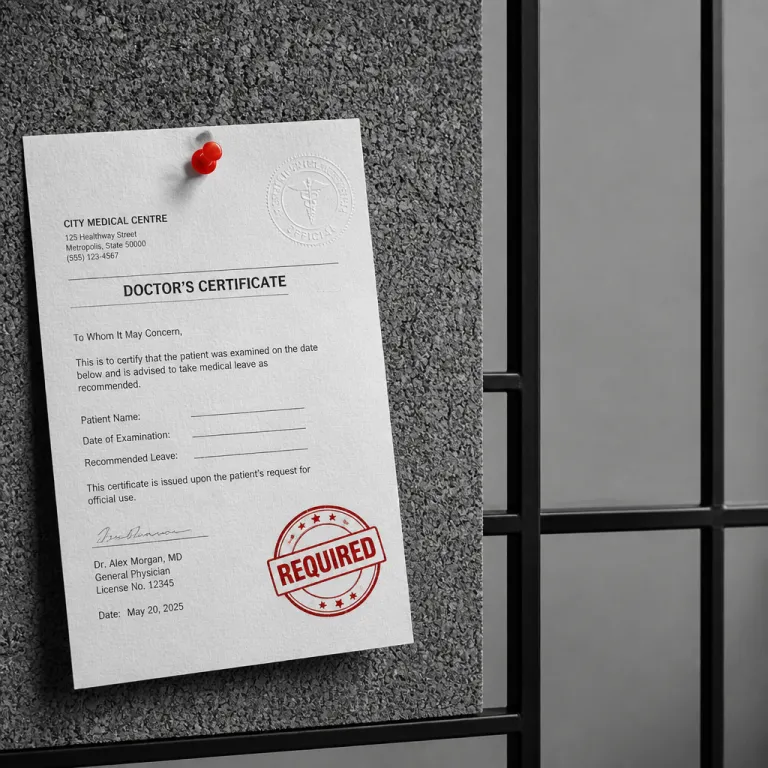
Reframing the question: when can an employer require a doctor’s note
Every CEO eventually faces the same governance question about health and attendance. When your leadership team asks “can an employer require a doctor s note”, they are really asking how much control you want over sick leave without damaging trust or violating law. A clear answer shapes how every manager treats an employee who is sick and needs time away from work.
From a governance perspective, the issue is not only whether an employer can request a medical note, but when and how that employer request is made across different business units. Federal frameworks such as the Family and Medical Leave Act, usually called FMLA, and the Americans with Disabilities Act, or ADA, define boundaries for any employer require policy on medical documentation. Your board expects you to ensure that every leave employer decision aligns with these statutes while still protecting productivity and culture.
State and city rules on paid sick leave and earned sick time now add another layer of complexity. Many jurisdictions restrict when employers may request doctor certification, especially for absences shorter than three consecutive days of work. As a result, any global or national policy on doctor note requirements must be modular enough to respect local law while still giving leaders reliable verification mechanisms.
Legal guardrails: FMLA, ADA and state paid sick leave regimes
When your general counsel answers “can an employer require a doctor s note”, they start with FMLA and ADA guardrails. Under FMLA leave rules, an employer may request medical documentation to verify a serious health condition, but that documentation must be limited to what is necessary to determine eligibility and duration. The ADA allows an employer request for medical information only when it is job related and consistent with business necessity, especially where work restrictions or accommodations are at stake.
State and municipal paid sick leave statutes complicate any uniform global rule on when an employer require a doctor note. Many paid sick leave laws prohibit employers from demanding a note for one or two consecutive days of absence, and some only allow a request doctor requirement after three consecutive workdays. In practice, this means your policy must distinguish between short term employee sick absences covered by earned sick time and longer medical leave events that justify more detailed medical documentation.
Governance also intersects with at will employment doctrines and local employment law risk. For example, when you review how at will rules reshape CEO governance strategy in jurisdictions such as New Jersey, you see how inconsistent enforcement of sick leave rules can trigger retaliation or discrimination claims. A board ready CEO will insist that every employer, from line manager to regional director, applies the same reasonable documentation standard whenever they request doctor verification for time away from work.
Policy design: setting thresholds for notes, verification and return to work
Once you understand the legal frame, the next question after “can an employer require a doctor s note” is where to set thresholds. Many employers adopt a rule that a doctor note is required after three consecutive days of absence, while shorter sick leave can be self certified by the employee. This three consecutive days threshold aligns with common state law standards and reduces unnecessary health care visits for minor illnesses.
For longer medical leave or patterns of intermittent absence, you may authorise an employer request for more detailed medical documentation from a licensed health care professional. That documentation should confirm the need for time away from work, expected consecutive days or weeks of leave, and any work restrictions that will apply when the employee returns. However, it must not disclose diagnosis details beyond what law permits, because employers must handle medical information obtained from doctor's notes confidentially, in compliance with privacy laws.
Return to work rules deserve equal attention in your governance framework. A clear policy can state when an employee sick after surgery or serious illness must provide a doctor note before they return work, especially if there are safety sensitive duties. For a deeper operating model view, many CEOs link these rules to how they design an HR department structure that accelerates CEO strategy, ensuring that HR, Legal and Operations jointly own verification, tracking of consecutive workdays absent, and communication with the care provider.
Governance and accountability: who owns sick leave decisions in your organisation
The governance challenge behind “can an employer require a doctor s note” is about decision rights. If every supervisor can independently request doctor verification for any employee sick for a single day, you will see inconsistent treatment and rising legal exposure. If only HR can approve medical leave and reasonable documentation standards, you risk bottlenecks and operational delays.
High performing boards clarify which roles can approve sick leave, extended FMLA leave, and ADA related accommodations, and they codify when an employer require note rule applies. Typically, line managers can approve short paid sick absences using self certification, while HR business partners handle any employer request for medical documentation beyond a set number of consecutive days. This division of responsibility ensures that complex cases involving medical leave, work restrictions or overlapping FMLA and ADA rights receive expert review.
To support this, CEOs commission clear governance policies on when a doctor’s note is required for work and how verification is stored and audited. These policies should specify how many consecutive workdays trigger a doctor note requirement, how earned sick time interacts with unpaid leave, and how leave employer decisions are escalated. Over time, a disciplined governance model reduces grievances, stabilises attendance patterns and signals that the employer values both performance and employee health.
Strategic culture: balancing trust, privacy and performance in medical leave
How you answer “can an employer require a doctor s note” sends a cultural signal as strong as any town hall speech. A policy that demands a doctor note for every single sick day may technically comply with law, yet it communicates distrust and ignores the real cost of unnecessary health care visits. Conversely, a system with no verification for extended medical leave can invite abuse and frustrate high performing teams that must cover repeated absences.
Strategic CEOs treat sick leave as part of the social contract between employer and employee, not just an HR process. They design earned sick and paid sick frameworks that assume good faith, while reserving the right to request doctor verification when patterns of three consecutive or more days emerge or when safety critical work is involved. This approach respects privacy, reduces friction with health care providers, and still allows the employer to obtain reasonable documentation when business continuity is at risk.
Culture also depends on how managers talk about medical documentation and return work expectations. Training should emphasise that any employer request for a doctor note is about verification of capacity, not suspicion of dishonesty, and that ADA and FMLA leave rights are non negotiable. Over time, employees learn that when they are genuinely employee sick, the organisation will provide time, support and clarity about any work restrictions needed for a safe and sustainable return.
Execution playbook for CEOs: from policy text to daily practice
Even the best written answer to “can an employer require a doctor s note” fails if execution is weak. Your first task is to align policy language on sick leave, earned sick time, FMLA leave and ADA accommodations with real workflows in scheduling, payroll and performance management. That means mapping how an employee sick absence moves from initial request, to any employer request for medical documentation, to final approval and tracking of consecutive days away from work.
Next, you need a monitoring system that flags when consecutive workdays of absence approach the threshold that triggers a doctor note requirement. HR analytics can show patterns where certain employers or teams overuse request doctor options or ignore law based limits on when they can demand a note. When those patterns appear, you intervene with targeted training or governance changes so that every leave employer decision reflects both legal compliance and your cultural standards.
Finally, embed these rules into your broader governance architecture and board reporting. Regular updates should cover how many employees used paid sick or unpaid medical leave, how often an employer require note rule was applied, and whether any disputes arose over work restrictions or return work clearances. For practical guidance on policy wording and escalation paths, CEOs can review specialised resources on how they should govern policies on when a doctor’s note is required for work and adapt those principles to their own risk appetite and organisational design.
Key statistics and regulatory benchmarks for CEO decision making
- Federal guidance under FMLA allows employers to request medical certification for serious health conditions, but the information must be limited to what is necessary to determine eligibility, which constrains how much medical documentation you can collect for each medical leave case (source: U.S. Department of Labor FMLA regulations).
- An increasing number of states and cities have enacted paid sick leave laws that restrict employers from requiring a doctor's note for short absences, often defined as three days or fewer, which means national employers must localise their sick leave and doctor note policies to avoid non compliance (source: state and municipal labour department summaries).
- Many employers implement a policy that requires a doctor's note after three consecutive days of absence, applied uniformly to all staff, because this three consecutive days standard balances verification needs with employee privacy and health care system capacity (source: multi employer policy surveys reported by employment law firms).
- Privacy rules require that employers handle medical information obtained from doctor's notes confidentially and prohibit them from requesting excessive medical details beyond what is necessary to verify the absence or accommodation request, which should shape your internal access controls and HR system design (source: Equal Employment Opportunity Commission guidance).
FAQ: governance questions CEOs ask about doctor’s notes and sick leave
Can an employer require a doctor’s note for every sick day
Legally, an employer can often request a doctor note, but many paid sick leave laws restrict this for short absences. Requiring medical documentation for every single sick day usually damages trust and may conflict with local law. Most large employers instead require a note only after a defined number of consecutive workdays or where safety risks justify verification.
When should a company request medical documentation under FMLA
Under FMLA, an employer may request medical certification when an employee seeks leave for a serious health condition or to care for a family member. The documentation must come from a health care provider and be limited to information needed to confirm eligibility and expected duration. CEOs should ensure that only trained HR staff review these FMLA leave certifications and that renewals are requested only at legally permitted intervals.
How do ADA rules affect return to work and work restrictions
The ADA allows an employer to request medical information when it is job related and consistent with business necessity, especially when determining work restrictions or accommodations. When an employee returns to work after medical leave, you may ask for a doctor note confirming fitness for duty and any limitations. However, you cannot demand broad medical history or use the information to discriminate against the employee.
What is a reasonable threshold for requiring a doctor’s note
Many organisations use a threshold of three consecutive days of absence before requiring a doctor note, because this aligns with several state sick leave laws. Shorter absences are usually covered by earned sick or paid sick policies without formal verification. CEOs should validate this threshold with legal counsel and adjust it in jurisdictions where law sets different limits on employer request practices.
How should medical information from doctor’s notes be stored and accessed
Medical documentation from doctor notes must be stored separately from general personnel files with strict access controls. Only HR or designated compliance staff should see details from a care provider, and managers should receive only information about work restrictions or return work dates. This approach aligns with privacy law expectations and reduces the risk of discrimination claims based on health information.
