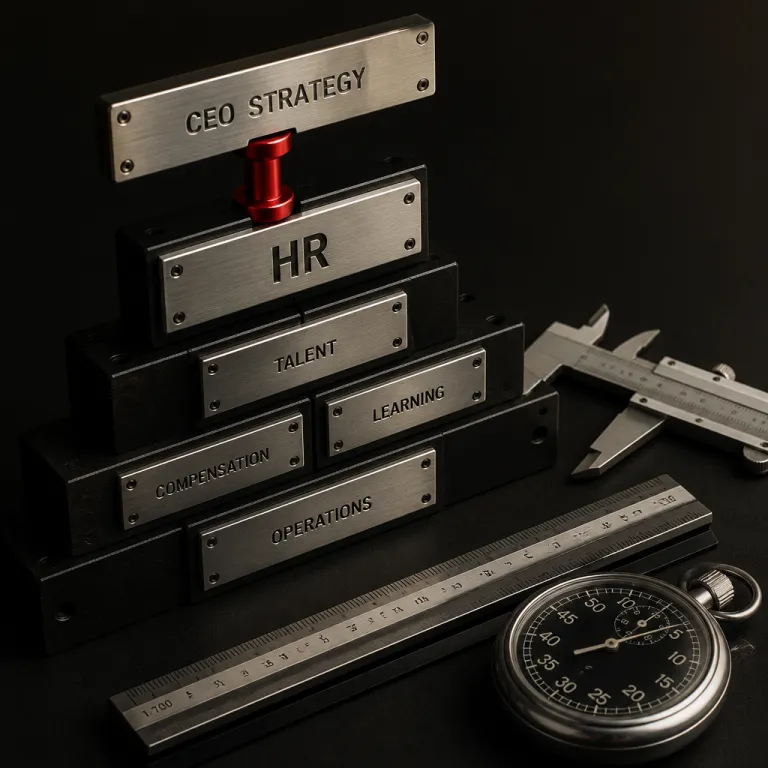
Why your hr department structure is now a core strategic lever
The way you design your HR department structure now shapes how quickly your strategy turns into measurable performance. A fragmented structure inside the human resources department slows decision making, weakens employee relations, and leaves your workforce planning reactive instead of predictive. When your organizational structure for HR is intentional, the company gains a clear operating model that aligns people, teams, and resources with the business agenda.
Across organizations, the median ratio of 1.4 HR professionals per 100 employees shows how lean this function often is, so every role and every structure choice matters. In small businesses, one HR generalist or a compact team may cover multiple functions, while larger organizations rely on specialist groups for talent acquisition, compensation and benefits, and learning and development. The question for any CEO is not how big the department is, but whether the department structure and reporting lines enable fast, high quality decision making that supports growth and risk management.
Modern HR organizations are shifting toward a business partner model that embeds human resources expertise inside business units. This HR business partner model connects HR teams directly to P&L leaders, so team members understand local workforce dynamics and can influence organizational structure and roles and responsibilities in real time. When these business partners are supported by strong central HR centers of excellence, the overall structure becomes a strategic asset rather than a back office cost center.
From administrative function to strategic operating model
Many CEOs still inherit an HR department whose primary functions are payroll, compliance, and basic employee relations. That administrative structure keeps the company legally safe, but it does little to shape the workforce or the broader organization in line with strategy. To compete, you need an HR operating model that treats human capital as a core business resource, not a support activity.
A strategic HR operating model usually combines three elements in one coherent organizational structure. First, HR business partners sit close to business leaders and guide decision making on workforce planning, org chart design, and team structures that match commercial priorities. Second, specialist teams handle talent acquisition, compensation and benefits, and learning and development, ensuring deep expertise in these critical functions and freeing business partners to focus on strategic management questions.
Third, a shared services department centralizes repeatable processes for employees, such as onboarding, employee data changes, and standard employee relations queries. This shared services structure reduces manual processes that create operational inefficiency and undermine digital transformation goals, as explored in this analysis of how manual processes create operational inefficiency. When these three components operate as one integrated HR organization, team members can move between teams, roles, and functions as demand shifts, giving the company a more agile workforce engine.
Designing the right organizational structure for different company sizes
The optimal HR department structure for a company with 120 employees will not match the structure required for a global organization with 20 000 employees. In smaller organizations, a generalist model where one HR professional or a small team covers multiple HR functions is often the only viable option. As the workforce scales, the complexity of employee relations, workforce planning, and talent acquisition quickly outgrows that simple model.
For small businesses, the priority is usually clarity of roles and responsibilities and simple reporting lines inside the HR department. One HR leader may oversee human resources, payroll, and basic learning and development, while a few team members handle recruitment, employee queries, and basic management reporting. In this context, the organizational structure should minimize handoffs, keep teams close to employees, and ensure that every employee knows exactly which HR team members to contact for which functions.
In larger organizations, specialist teams become essential to manage the scale and diversity of the workforce. Dedicated teams for talent acquisition, compensation and benefits, and leadership learning and development can design sophisticated programs that align with the company operating model and sector specific needs, such as complex supply chains in energy or manufacturing, which are discussed in this perspective on optimizing procurement and supply chain management. At this scale, the HR organizational structure must also support cross functional collaboration across geographies and business units, so that people processes remain consistent while allowing local adaptation.
Making reporting lines, roles, and the org chart work for CEOs
An org chart is not just a diagram of boxes and reporting lines inside the HR department. It is a visual representation of how power, information, and accountability flow through your human resources organization. When the HR org chart is misaligned with the company strategy, decision making slows, teams duplicate work, and employees receive inconsistent guidance.
Effective HR department structures start with a clear definition of roles and responsibilities for every HR position, from HR director to HR business partner to specialist and shared services agent. Each role should specify which business outcomes it owns, which people or teams it supports, and how it interacts with other HR functions such as talent acquisition, compensation and benefits, and learning and development. This clarity allows team members to collaborate across teams and organizations without confusion, especially in cross functional initiatives like leadership development or workforce planning for new markets.
For CEOs, the most important question is where HR sits in the overall company organizational structure. The HR leader should report directly to the CEO, with a mandate that spans the entire workforce and all business units, not just administrative functions. When HR is positioned as a true strategic partner, the department structure can evolve quickly as the company operating model changes, ensuring that people, teams, and resources remain aligned with long term value creation.
Embedding the HR business partner model for strategic impact
Modern HR departments are increasingly adopting the HR Business Partner model, integrating HR professionals directly into business units to align HR strategies with organizational goals. This business partner model moves HR from the sidelines into the core of business decision making, where human resources leaders can influence organizational structure, workforce planning, and team design in real time. For CEOs, the question is how to embed this partner model without creating confusion or fragmentation inside the HR department.
In a well designed partner model, each HR business partner supports a defined part of the organization, such as a region, product line, or function. These business partners sit on leadership teams, participate in strategic planning, and translate company strategy into concrete workforce actions, such as new roles, new teams, or changes to reporting lines. Behind them, central HR teams provide expertise in talent acquisition, compensation and benefits, learning and development, and employee relations, so that business partners can focus on strategic management rather than transactional tasks.
To make this structure work, CEOs must ensure that HR business partners are measured on business outcomes, not just HR activity metrics. Their performance should reflect improvements in workforce productivity, leadership bench strength, employee engagement, and the speed of organizational change. When the partner model is fully integrated, HR becomes a network of teams and organizations that can reconfigure quickly as the company operating model evolves, rather than a static department with rigid structures.
Linking hr department structure to governance, risk, and CEO oversight
HR is now central to governance, risk, and compliance, which means your hr department structure must support robust oversight. Issues such as employee relations, workplace safety, and regulatory compliance sit alongside strategic topics like workforce planning, leadership succession, and culture, all of which require clear organizational structure and transparent reporting lines. As CEO, you need an HR organization that can surface risks early and propose people centric solutions that align with the business model.
One practical step is to align HR governance with broader corporate governance frameworks, including board level committees and internal audit. This alignment can be supported by clear HR roles and responsibilities for risk management, defined escalation paths for serious employee relations issues, and regular reporting on workforce metrics that matter for long term value creation. For regulated environments, such as healthcare or complex labor law jurisdictions, guidance on strategic governance for CEOs illustrates how HR policies, department structures, and legal requirements intersect.
Finally, your HR operating model should enable cross functional collaboration between HR, finance, legal, and operations on topics like restructuring, mergers, and large scale workforce transitions. In these situations, the HR department structure must support rapid scenario modeling, transparent communication with employees, and coordinated action across teams and organizations. When HR is structured for this level of integration, it becomes a central pillar of enterprise risk management and a trusted partner in every major strategic move.
Key statistics on hr department structure and organizational efficiency
- The Society for Human Resource Management reports a median ratio of 1.4 HR professionals per 100 employees in U.S. organizations, highlighting how lean most HR teams are relative to the size of the workforce (SHRM, 2022 Human Capital Benchmarking Report, United States).
- In small organizations with fewer than 150 employees, a generalist HR model is most common, where one HR professional or a small team handles all major HR functions, which concentrates roles but can limit specialization (SHRM analysis of HR-to-employee ratios, 2022, United States).
- Larger organizations typically adopt a specialist HR model, with dedicated teams for recruitment and talent acquisition, training and learning and development, and compensation and benefits, which supports greater organizational efficiency at scale (SHRM, 2022 Human Capital Benchmarking Report, United States).
- HR departments are usually structured around core functions such as recruitment, compensation and benefits, compliance and employment law, employee relations, and workforce planning and development, reflecting a consistent organizational structure across many industries (SHRM, 2022 Human Capital Benchmarking Report, United States).
- Modern HR departments are increasingly adopting the HR Business Partner model, integrating HR professionals directly into business units to align HR strategies with organizational goals, which strengthens the link between people decisions and business performance (SHRM, 2022 Human Capital Benchmarking Report, United States).
FAQ: hr department structure for CEOs
How should a CEO decide on the right hr department structure?
A CEO should start by mapping the company strategy, operating model, and workforce complexity, then design an HR organizational structure that supports those realities. For a simple business with a small workforce, a lean generalist department may be sufficient, while diversified organizations usually need HR business partners, specialist teams, and shared services. The key is to ensure clear roles and responsibilities, efficient reporting lines, and a direct link between HR leadership and the CEO.
When is it time to move from a generalist HR model to specialists?
The shift from generalist to specialist HR structures typically occurs when the workforce grows beyond roughly 150 to 200 employees or when the business expands into multiple regions or product lines. At that point, the complexity of talent acquisition, compensation and benefits, and learning and development usually exceeds what a single HR generalist or small team can manage effectively. CEOs should watch for signs such as slow hiring, inconsistent employee relations handling, or over reliance on external consultants as triggers to redesign the department structure.
What is the role of HR business partners in organizational decision making?
HR business partners act as strategic advisors embedded within business units, translating company strategy into workforce planning, organizational structure changes, and leadership development actions. They participate in management meetings, influence decisions on team design and reporting lines, and coordinate with central HR functions on topics like talent acquisition and compensation and benefits. For CEOs, effective business partners provide a single point of contact who understands both the people and the financial dimensions of each part of the organization.
How can HR support cross functional transformation programs?
HR supports cross functional transformation by aligning workforce planning, learning and development, and change management with the program roadmap. A well structured HR department assigns clear roles and responsibilities for transformation, often through dedicated HR business partners and project focused teams that coordinate with operations, finance, and IT. This structure ensures that employees receive consistent communication, targeted training, and fair treatment during reorganizations or new operating model rollouts.
What metrics should CEOs use to assess HR organizational effectiveness?
CEOs should track a mix of efficiency and impact metrics, such as time to hire, internal mobility rates, leadership pipeline strength, and employee relations case resolution times. These indicators should be linked to business outcomes like revenue per employee, retention of critical roles, and the speed of integrating acquisitions or new teams. When the hr department structure is effective, these metrics show both operational reliability and a clear contribution to strategic goals.
