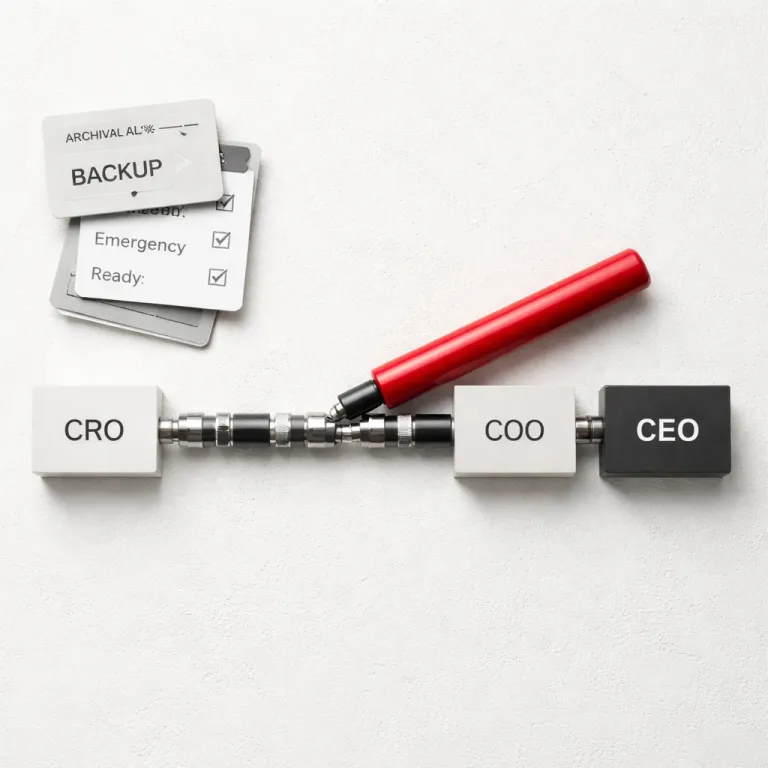
The executive mandate for CEO succession planning as a strategic asset
Executive summary. CEO succession is now a core strategic capability, not a narrow governance formality. Rising CEO turnover, shorter tenures and activist pressure mean that every leadership change can either unlock value or trigger costly disruption. Boards that treat succession as an always-ready pipeline—anchored in a clear CEO success profile, robust internal and external benchmarking, and a disciplined governance architecture—are better positioned to protect enterprise value under stress. This article outlines how to redesign CEO succession planning across three time horizons (emergency, medium term and long term), how to integrate AI-era competencies without losing the human core of leadership and how to operationalize readiness through a practical, one-page CEO succession dashboard.
CEO succession planning is no longer a governance hygiene factor; it is a core strategic capability. When more than 1,400 chief executives in the United States resigned in a single year and median CEO tenure in the S&P 500 fell below five years, the risk profile of the CEO role changed structurally.1 For any company that aspires to sustained outperformance, the board must treat every CEO transition as a value inflection point rather than a one-off event.
For a sitting CEO and the board directors who oversee succession, the central question is simple but unforgiving: Will your succession plan protect enterprise value under stress, or will the succession process itself become the crisis that defines your leadership legacy? The Disney transition from Bob Iger to Bob Chapek illustrates this risk. In February 2020, Chapek was appointed CEO while Iger remained as executive chairman with control over creative decisions; by late 2022, after strategic missteps and internal tension, Chapek was removed and Iger returned as CEO. The combination of split authority, unclear decision rights and limited board alignment has become a featured case study in how fragile succession plans can destabilize even world-class brands.
Boards that still treat CEO succession as an emergency backup are exposed on three fronts. First, they underestimate the long-term cost of failed CEO transitions, which independent analysis for the S&P 1500 estimates at close to one trillion dollars per year in lost performance and strategic drift.2 Second, they overlook how a robust planning process signals to internal candidates, external candidates and investors that leadership development is taken seriously as a strategic discipline. Third, they miss the opportunity to use CEO succession as a lever to refresh strategy, culture and capital allocation priorities.
The shift from episodic to always-ready CEO succession planning requires a different mindset. Instead of a confidential file updated before the annual general meeting, the succession plan becomes a living management tool that shapes leadership development, capital deployment and risk oversight. In this model, the CEO succession agenda is integrated into the board menu of recurring topics, with explicit time carved out at every strategy offsite and at least one regular board meeting each year.
For C-suite leaders, the implication is clear. You cannot outsource the CEO succession agenda to human resources or to the nomination committee and hope that a robust succession planning template will emerge organically. The CEO, the lead independent director and the chair of the nomination and governance committee must jointly own the succession planning process as part of the executive mandate to protect the company’s future.
From episodic event to always-ready pipeline: redesigning the succession process
The always-ready pipeline model treats CEO succession as a continuous search and calibration exercise, not a one-time event triggered by a resignation. In this approach, boards maintain a dynamic slate of potential successors, including both internal candidates and external candidates, and they revisit that slate at least twice a year. The goal is not to predict the exact timing of a CEO transition but to ensure that the company can execute a high-quality CEO succession under any scenario.
Several trends make this shift urgent for boards and management teams. CEO changes in high-performing S&P 500 companies rose from 7 percent to 12 percent within a short period, while the Russell 3000 maintained a steady succession rate of around 11 percent, which means that even well-run companies are cycling through CEOs faster.3,4 At the same time, research shows that 62 percent of externally hired CEOs need more than six months to reach full productivity, which amplifies the risk when a succession plan relies too heavily on a late-stage external search.5
In a continuous model, the planning process is structured around three distinct but connected time horizons:
- Emergency horizon (first 30–90 days) – specifies which executive will step in, how authority will be delegated and what communication steps the board will take with investors and employees.
- Medium term (1–3 years) – defines a clear success profile for the CEO role and a development roadmap for each of the leading internal candidates.
- Long term (>3 years) – links CEO succession planning directly to strategy, capital allocation and portfolio choices.
The long-term horizon is where the board directors ask which CEO capabilities the company will need in the future, given its growth markets, technology bets and regulatory exposure. This is also where the board menu should include a recurring discussion on activist pressure and governance trends, building on insights similar to those highlighted in analyses of board behaviors during AGM season, such as those discussed in board behaviors that turn activist pressure into strategic clarity.
To make the always-ready pipeline real, boards must institutionalize the succession process through governance structures, not personal relationships. That means defining a standard planning template, clarifying which committee owns which part of the process and agreeing how often the full board will review the CEO succession dashboard. It also means that the current CEO accepts that succession planning is part of their leadership duty, not a threat to their authority or tenure.
Governance architecture: how boards keep CEO succession out of the shadows
When CEO succession planning fails, the root cause is often governance, not talent scarcity. Too many boards allow the topic to become the chairman’s private project or a confidential conversation between the chair and the current CEO, with limited visibility for the rest of the board directors. That structure almost guarantees blind spots in the succession plan and undermines the board’s collective accountability for the CEO role.
A more resilient architecture starts with committee design and clear charters. The nomination and governance committee should own the formal succession process, including the planning template, the success profile for the CEO role and the cadence of internal and external benchmarking. The compensation committee should align incentives, ensuring that the current CEO and key executives are rewarded for building a strong bench of potential successors rather than hoarding power.
Board leadership also matters. The lead independent director or non-executive chair should facilitate open discussion about CEO succession planning in full board sessions, not just in closed one-on-one meetings. That includes explicit debate about internal candidates versus external candidates, the long-term leadership development agenda and the risk trade-offs of different succession plans under various strategic scenarios.
For complex companies, a dedicated succession subcommittee can be justified, especially when multiple executive roles are in motion. This subcommittee can coordinate with the chair of the nomination committee and with the chairperson selection process, which is itself a critical governance decision, as explored in guidance on understanding the selection process for a chairperson. The objective is not to create bureaucracy but to ensure that CEO succession is treated with the same rigor as capital allocation or major acquisitions.
Finally, the board must define how information will flow between committees, the full board and the executive team. A concise CEO succession dashboard, updated at least annually, should summarize the planning process, highlight the leading internal candidates, outline the external market view and flag any emerging risk in the pipeline. A practical, one-page dashboard might include four sections:
- Succession map – list of primary and secondary successors, with a readiness score for each (e.g., ready now, 1–2 years, 3+ years) and identified gaps.
- Bench strength metrics – a bench depth index (number of credible successors per critical role), diversity indicators and retention risk for key executives.
- Market calibration – an external match metric comparing internal candidates to market benchmarks on experience and skills, plus a short summary of external talent pools.
- Transition risk view – estimated time-to-ramp for internal versus external successors based on past transitions, scenario-based risk ratings and planned mitigation actions.
When this governance architecture is in place, CEO transitions become managed strategic events rather than opaque, personality-driven dramas.
Designing the success profile and benchmarking internal candidates against the market
The heart of effective CEO succession planning is a sharp, forward-looking success profile for the CEO role. This success profile should translate the company’s strategy, risk appetite and capital allocation priorities into a concrete set of leadership requirements. Without that clarity, the succession process devolves into a popularity contest among senior executives or a reactive search for a celebrity external hire.
Boards should start by asking what the company will need from its CEO in the next strategic cycle, not what made the current CEO successful in the past. If the company is pivoting toward software, data and AI-enabled services, the success profile must emphasize technology fluency, ecosystem orchestration and the ability to manage platform risk. If the company faces heavy regulatory scrutiny or activist pressure, the CEO role may require exceptional stakeholder management and capital markets communication skills.
Once the success profile is defined, the board and management can assess internal candidates against it in a structured way. That means using multiple lenses, including performance track record, potential, learning agility and values alignment, rather than relying solely on the current CEO’s informal ranking. It also means exposing potential successors to stretch roles, cross-functional assignments and external visibility, so that the board can observe how they operate under pressure.
Benchmarking against the external market is essential, but it must be handled carefully to avoid demoralizing the internal bench. Boards can commission periodic external search scans to understand how their internal candidates compare with external candidates on experience, skills and compensation expectations. These scans should be framed as a way to calibrate the succession plan and refine leadership development, not as a vote of no confidence in the internal pipeline.
Transparent communication is critical. The current CEO and the head of human resources should explain to internal candidates how the planning process works, what the long-term development expectations are and how external benchmarking fits into the overall succession planning agenda. When handled with respect and clarity, this approach strengthens engagement and retention, because high-potential executives see that the company takes their growth and the future CEO transition seriously.
Integrating AI-era competencies into CEO succession without losing the human core
Many boards acknowledge that AI and data are reshaping competitive dynamics, yet they struggle to translate that reality into CEO succession planning. The risk is that the success profile for the CEO role becomes either too generic on technology or unrealistically biased toward pure technologists who may lack enterprise leadership depth. A more balanced approach treats AI-era competencies as non-negotiable elements of the leadership portfolio, but not as the only criteria that matter.
At a minimum, future CEOs must be able to ask the right questions about AI, data governance and digital risk, even if they are not engineers by training. They need enough fluency to challenge management on algorithmic bias, cybersecurity exposure and the ROI of large-scale technology investments, and they must understand how AI can reshape the company’s operating model and talent strategy. This level of literacy should be explicitly built into the success profile and into the leadership development plans for potential successors.
Boards should also examine how AI tools can strengthen the succession process itself. Advanced analytics can help identify patterns in executive performance, flagging internal candidates whose trajectory suggests readiness for bigger roles sooner than expected. AI-enabled market scans can enrich the external search by mapping executive movements across sectors, highlighting external candidates who bring rare combinations of skills relevant to the company’s future.
However, AI cannot replace the board’s judgment about character, values and cultural fit. The Disney example, where the new CEO struggled with authority and support despite a seemingly logical succession plan, underlines how critical these human factors are. Boards must therefore treat AI as an input into CEO succession planning, not as an automated decision engine that selects the next chief executive from a digital menu of résumés.
For sitting CEOs, integrating AI-era competencies into succession planning is also a personal leadership challenge. They must role-model continuous learning, show how they use AI responsibly in their own decision making and sponsor development experiences that expose potential successors to real-world technology decisions. When the current CEO behaves this way, the message to the organization is clear: the future of leadership will be both deeply human and intelligently augmented.
Emergency succession versus planned transition: two playbooks, one standard of readiness
Every board needs two distinct CEO succession playbooks: one for emergency succession and one for a planned CEO transition. The emergency plan addresses scenarios such as sudden illness, scandal or unexpected resignation, where the company must act within hours or days to stabilize leadership. The planned transition playbook covers orderly CEO transitions, where the timing is known months in advance and the board can orchestrate a more deliberate process.
Emergency succession checklist (first 30–90 days)
- Confirm interim CEO and clarify decision rights with the board within 24–48 hours.
- Issue coordinated communications to employees, investors, regulators and key partners.
- Stabilize the executive team and confirm continuity of critical initiatives.
- Launch a rapid assessment of reputational, legal and operational risks linked to the departure.
In an emergency, the priority is continuity of operations and stakeholder confidence. A clear process reduces confusion, limits rumor-driven risk and signals that the board and management have anticipated this possibility as part of responsible CEO succession planning.
Planned transition checklist (first 100 days of the new CEO)
- Define a detailed transition plan and clarify the outgoing CEO’s role after the handover.
- Align on a concise mandate and success metrics for the first 100 days.
- Schedule structured onboarding with key investors, regulators, customers and internal leaders.
- Use a phased communication plan to explain the leadership change and strategic continuity.
Planned CEO transitions allow for a richer set of options, including staged handovers, co-leadership periods and structured onboarding for an external hire. Resources such as a five-phase framework for the first 100 days, like the one outlined in a structured first 100 days as CEO framework, can help boards and executives align on what success looks like in the early phase.
Despite these differences, the standard of readiness should be the same for both emergency and planned succession. Boards should regularly stress test their CEO succession plans against multiple scenarios, asking whether the company could handle a CEO transition during a major acquisition, a cyber incident or a liquidity squeeze. They should also review whether the current CEO and the executive team understand their roles in each scenario and whether potential successors have been briefed on what would be expected of them.
When CEO succession planning reaches this level of maturity, it ceases to be a reactive safety net and becomes an always-ready strategic asset. The board, the CEO and the broader management team can then focus on executing the company’s strategy with confidence, knowing that leadership continuity is not left to chance. As one leading advisory firm has noted, “The cost of failed CEO and C-suite successions is estimated to be close to $1 trillion per year for the S&P 1500 companies.”2
Key figures that reshape the CEO succession agenda
- More than 1,400 CEOs in the United States resigned in a recent year, the highest number since the mid-2010s, which underscores how frequently boards now face CEO transitions and why an always-ready pipeline is essential (Deloitte analysis based on public filings and press releases).1
- The median CEO tenure in S&P 500 companies declined from around six years to 4.8 years over less than a decade, compressing the time window in which a current CEO can execute their strategy and prepare a robust succession plan (Deloitte research using longitudinal tenure data for large-cap CEOs).1
- CEO turnover in S&P 500 companies increased while the Russell 3000 maintained a steady succession rate of approximately 11 percent, showing that even large-cap boards are not insulated from leadership volatility (PwC Governance Insights Center analysis of CEO changes across major U.S. indices).4
- The estimated cost of failed CEO and C-suite successions approaches one trillion dollars per year for S&P 1500 companies, reflecting lost growth, strategic reversals and value destruction during poorly managed CEO transitions (Deloitte estimate combining market-cap movements and performance shortfalls after leadership changes).2
- In high-performing S&P 500 companies, CEO changes rose from 7 percent to 12 percent within a short period, indicating that even successful boards are making more frequent leadership shifts as performance expectations and market conditions evolve (VantEdge Search data based on proprietary tracking of CEO appointments and departures).3
- Approximately 62 percent of externally hired CEOs require more than six months to reach full productivity, which highlights the execution risk when succession plans rely heavily on late-stage external searches without strong internal candidates (various leadership advisory studies using surveys and performance ramp-up analyses).5
Source notes
1 Deloitte CEO succession and turnover studies aggregate CEO changes across major U.S. indices using regulatory filings, company announcements and press coverage, then calculate tenure and turnover trends over multi-year periods. For example, see Deloitte, CEO Transitions in the U.S. Capital Markets, 2019–2023 editions.
2 Deloitte’s estimate of the cost of failed successions combines abnormal shareholder returns, missed growth versus peers and write-downs following poorly managed CEO and C-suite transitions across S&P 1500 companies. See Deloitte, The High Cost of Poor CEO Succession, 2017, pp. 4–7.
3 VantEdge Search compiles CEO transition data for high-performing S&P 500 companies, defining “high performing” based on multi-year total shareholder return relative to the index and tracking changes in CEO turnover rates. See VantEdge Search, CEO Turnover in High-Performing Companies, 2020, Exhibit 2.
4 PwC’s Governance Insights Center analyzes CEO turnover in the S&P 500 and Russell 3000 using public disclosures, categorizing transitions by reason (planned vs. unplanned) and calculating annual turnover percentages. See PwC, CEO Success and Succession, 2019–2022 reports.
5 Leadership advisory firms derive the 62 percent figure from surveys of boards and CHROs, combined with performance data on externally hired CEOs, measuring time-to-productivity against pre-defined operating and financial targets. See, for example, Russell Reynolds Associates, External CEO Hires: Time to Full Effectiveness, 2018, pp. 5–6.
FAQ: CEO succession planning for boards and C-suite leaders
How often should a board review its CEO succession plan?
A board should conduct a formal review of its CEO succession plan at least once a year and a lighter check-in at every major strategy offsite. High-velocity environments or companies undergoing transformation may require semiannual deep dives into the succession process and the slate of potential successors. The key is to treat CEO succession planning as a standing agenda item, not as a response to rumors about the current CEO’s tenure.
What is the right balance between internal candidates and external candidates?
Most governance experts recommend that boards prioritize strong internal candidates while maintaining a clear view of the external market. Internal successors typically ramp faster, understand the culture and signal stability to employees and investors, but external candidates can bring fresh perspectives and capabilities that the company lacks. A robust succession plan usually includes two or three credible internal candidates and a periodically refreshed external benchmark list, without committing prematurely to either path.
How transparent should the current CEO be with potential successors?
The current CEO should be candid about the existence of a structured succession process and about the development expectations for potential successors, without making promises about timing or outcomes. Transparency about the success profile, the planning process and the role of the board helps internal candidates understand what is required and reduces anxiety about opaque decision making. However, boards and CEOs should avoid signaling that any individual is the guaranteed heir apparent until a formal decision is made.
What distinguishes an emergency succession plan from a planned transition?
An emergency succession plan focuses on immediate continuity, specifying who will serve as interim CEO, how authority will be delegated and how stakeholders will be informed within the first days and weeks. A planned transition plan, by contrast, covers months of preparation, including selection, onboarding, communication strategy and the outgoing CEO’s role after the handover. Both plans should be documented, tested and aligned with the company’s broader risk management framework.
How should boards integrate AI and technology into CEO succession planning?
Boards should explicitly include AI and digital competencies in the success profile for the CEO role, ensuring that potential successors can oversee technology strategy, data governance and cyber risk. They can also use analytics to enrich the succession process, for example by identifying performance patterns among executives or mapping external talent pools. However, final decisions about CEO succession must remain grounded in human judgment about character, values and cultural fit, with AI serving as a decision support tool rather than a replacement for board responsibility.